시제품 없이 특허출원 가능한가요? 아이디어 구체화와 준비자료
완성된 시제품이 없어도 특허출원을 검토할 수 있습니다. 다만 단순히 “이런 제품이 있으면 좋겠다”는 아이디어와 실제로 특허 명세서를 작성할 수 있을 정도로 구체화된 발명은 다릅니다. 시제품이 없는 단계에서 어느 정도까지 기술을 정리해야 하는지, 어떤 자료를 준비해야 하는지, 공개 전에 무엇을 주의해야 하는지를 사례와 함께 설명합니다.
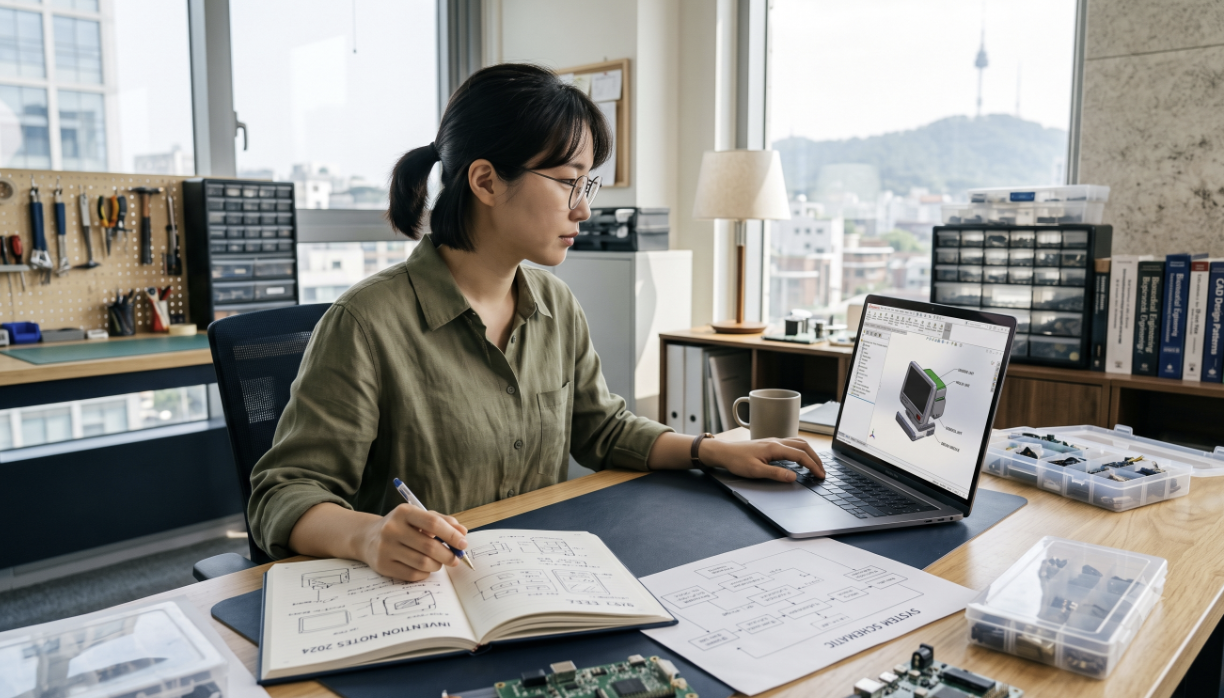
결론부터 말하면, 완성된 시제품이 없어도 특허출원을 검토할 수 있습니다.
특허출원을 위해 완성된 제품을 특허관청에 가져가서 보여주거나 실제 시제품을 제출해야 하는 것은 아닙니다. 더 중요한 것은 아이디어가 단순한 희망이나 기능 설명을 넘어, 어떤 기술적 수단으로 문제를 해결하는지 설명할 수 있을 정도로 구체화되어 있는가입니다.
따라서 “시제품이 있느냐 없느냐”만으로 출원 가능 여부를 판단하기보다는 다음 질문을 먼저 해보는 것이 좋습니다.
핵심 질문
이 발명의 구조, 작동방법 또는 처리과정을 설명했을 때 해당 분야의 기술자가 실제로 어떻게 구현하는지 이해할 수 있는가?
이 질문에 상당 부분 답할 수 있다면 시제품이 없어도 특허출원 전략을 검토할 수 있습니다.
시제품이 없는데 어떻게 특허를 출원할 수 있을까요?
특허는 완성품 그 자체를 보관해 두는 제도가 아니라 발명을 문서로 설명하고 그중 보호받고 싶은 기술적 범위를 청구항으로 정하는 제도입니다.
현행 특허법 제42조는 발명의 설명을 해당 기술분야에서 통상의 지식을 가진 사람이 쉽게 실시할 수 있도록 명확하고 상세하게 적도록 규정하고 있습니다.
따라서 특허출원에서 중요한 것은 “제품을 실제로 한 개 만들었는가”보다 발명을 충분히 기술적으로 설명할 수 있는가입니다.
예를 들어 다음 두 아이디어를 비교해보겠습니다.
아직 목적에 가까운 아이디어
“젖은 우산을 실내에 두어도 물이 바닥에 떨어지지 않았으면 좋겠다.”
해결하고 싶은 문제는 분명합니다.
하지만 이 문장만으로는 물을 어떻게 처리할지, 어떤 구조를 사용할지, 어느 부분이 기존 우산과 다른지를 알기 어렵습니다.
기술적 해결방법까지 구체화된 아이디어
“우산 손잡이 내부에 물을 수용하는 공간을 만들고, 우산을 세웠을 때 우산대 주변을 따라 내려온 물이 특정 유로를 통해 손잡이 내부 저장공간으로 이동하도록 구성한다.”
여기에 배수구조, 저장공간 위치, 결합관계, 물이 역류하지 않도록 하는 구조 등을 설명할 수 있다면 훨씬 구체적인 발명이 됩니다.
두 경우 모두 시제품은 없을 수 있습니다.
하지만 특허출원을 검토할 수 있는 기술적 준비 수준은 크게 다릅니다.
SKY POINT
시제품의 유무보다 중요한 것은 “문제 → 해결수단 → 구성 또는 단계 → 작동관계 → 효과”가 연결되어 있는지입니다.
아이디어는 어느 정도까지 구체화해야 할까요?
아래처럼 세 단계로 생각하면 이해하기 쉽습니다.
| 현재 상태 | 특허출원 검토 관점 |
|---|---|
| 해결하고 싶은 문제만 있음 | 기술적 해결수단을 조금 더 구체화할 필요가 있음 |
| 핵심 구조·방법·작동원리를 설명할 수 있음 | 시제품이 없어도 선행기술조사와 출원 검토 가능 |
| 기본 발명은 구체적이고 여러 대체구조까지 검토됨 | 보다 넓은 명세서·청구항 전략을 설계하기 좋은 단계 |
1. 문제만 있고 해결방법이 아직 없는 경우
“자동으로 분리수거해 주는 쓰레기통을 만들고 싶다.”
“반려동물이 혼자 있어도 외롭지 않은 기기를 만들고 싶다.”
“배터리가 오래 가는 장치를 만들고 싶다.”
이런 아이디어는 출발점으로는 충분히 의미가 있습니다.
하지만 특허 관점에서는 무엇을 이용해 어떻게 해결할 것인지가 더 필요합니다.
센서를 이용하는지, 기계적 구조를 이용하는지, 특정 데이터 처리방식을 이용하는지, 여러 요소의 결합관계가 핵심인지 등을 정리해야 합니다.
2. 핵심 작동원리를 설명할 수 있는 경우
반대로 시제품은 없지만 다음 내용을 설명할 수 있다면 상당히 달라집니다.
- 기존 제품의 어떤 점이 문제인지
- 어떤 구성요소를 새로 넣는지
- 구성요소들이 어떻게 연결되는지
- 사용자가 작동시키면 어떤 순서로 동작하는지
- 기존 방식과 비교해 어떤 효과가 생기는지
이 정도가 되면 손으로 그린 그림이나 간단한 흐름도만 있어도 상담과 선행기술 검토를 시작할 수 있습니다.
3. 여러 구현방법까지 생각해 본 경우
특허 명세서를 작성할 때는 현재 생각한 제품 한 개만 그대로 옮겨 적는 것보다 같은 기술적 원리를 다른 방식으로 구현할 가능성까지 생각해보는 것이 중요합니다.
예를 들어 센서 A만 생각했다면:
- 다른 종류의 센서로 바꿀 수 있는가?
- 직접 측정 대신 계산값으로 판단할 수 있는가?
- 서버에서 처리하던 것을 단말에서 처리할 수 있는가?
- 부품의 위치를 바꿔도 핵심 원리가 유지되는가?
같은 질문을 검토할 수 있습니다.
이런 대체구조를 미리 생각하면 특정 시제품 하나에만 권리범위가 묶이는 위험을 줄이는 데 도움이 됩니다.
실제 사례 1 — 택배상자를 안전하게 여는 도구
개인발명자가 이런 생각을 했다고 가정해보겠습니다.
“택배상자를 칼로 열 때 칼날이 너무 깊게 들어가서 안에 있는 상품이 손상되는 것을 막고 싶다.”
아직 시제품은 없습니다.
경우 A — 아이디어만 있는 상태
“상품이 안 다치는 안전한 택배칼이면 좋겠다.”
이 정도라면 해결목적은 있지만 구체적인 기술수단은 부족합니다.
경우 B — 구조가 정해진 상태
발명자가 다음과 같이 설명할 수 있다고 가정해보겠습니다.
- 칼날이 일정 길이 이상 돌출되지 않도록 하는 제한구조
- 상자 표면에 먼저 닿는 가이드부
- 사용자가 누르는 힘에 따라 칼날 위치가 조정되는 결합구조
- 칼날의 최대 진입깊이를 제한하는 스토퍼
실제 제품을 아직 만들지 않았더라도 각 부품의 관계와 작동방식을 그림으로 설명할 수 있다면 특허 검토를 시작할 수 있습니다.
차이는 시제품이 아니라 기술적 구체성입니다.
실제 사례 2 — 앱이나 소프트웨어도 시제품이 꼭 있어야 할까요?
소프트웨어·앱 분야에서도 비슷합니다.
“사람에게 맞는 운동을 추천해 주는 앱”이라는 생각만으로는 너무 넓습니다.
하지만 다음과 같이 구체화하면 상황이 달라집니다.
- 사용자의 특정 데이터를 입력받는다.
- 데이터에서 상태값을 산출한다.
- 일정 조건에 따라 운동군을 분류한다.
- 이전 수행결과에 따라 다음 추천값을 조정한다.
- 특정 위험조건이 감지되면 다른 처리경로로 전환한다.
앱 화면을 완전히 개발하지 않았더라도 입력값, 처리논리, 조건분기, 출력 및 기술적 효과가 구체적으로 설명될 수 있다면 특허 가능성 검토를 시작할 수 있습니다.
물론 모든 소프트웨어 아이디어가 특허가 되는 것은 아닙니다. 단순한 사업 아이디어나 추상적인 규칙과 특허법상 보호 가능한 발명은 구분해서 검토해야 합니다.
모든 분야에서 시제품의 중요성이 똑같지는 않습니다
여기서 한 가지 주의할 점이 있습니다.
주의
“시제품이 없어도 출원할 수 있다”는 말은 “기술적 검증이나 실험자료는 언제나 필요 없다”는 뜻이 아닙니다.
기계장치처럼 구조와 작동관계를 도면과 설명으로 비교적 명확하게 표현할 수 있는 발명도 있습니다.
반면 화학, 바이오, 의약, 재료 분야처럼 특정 조성·범위·조건에서 실제 효과가 나타나는지가 매우 중요한 분야에서는 실험결과와 기술적 근거의 중요성이 더 커질 수 있습니다.
따라서 같은 “시제품 없음”이라도 발명의 분야와 내용에 따라 필요한 준비 수준은 달라질 수 있습니다.
시제품이 없다면 상담 전에 무엇을 준비하면 좋을까요?
완성된 CAD 도면이나 정식 설계도부터 만들 필요는 없습니다.
다음 정도부터 정리해도 충분히 도움이 됩니다.
1. 해결하려는 문제
기존 제품이나 방법에서 무엇이 불편한지 적어봅니다.
2. 핵심 해결수단
문제를 해결하기 위해 새롭게 들어가는 구조, 단계, 데이터처리, 재료 또는 조건을 정리합니다.
3. 작동 순서
“입력 → 판단 → 처리 → 결과” 또는 “부품 A → 부품 B → 부품 C”처럼 관계를 설명합니다.
4. 기존 방식과 다른 부분
무엇 때문에 기존 기술과 결과가 달라지는지 생각합니다.
5. 대체 가능한 구조
현재 생각한 부품이나 방식 외에 다른 구현방법이 있는지 적어둡니다.
6. 손그림·사진·흐름도
잘 그릴 필요는 없습니다.
박스와 화살표만으로도 기술관계를 설명하는 데 큰 도움이 될 수 있습니다.
7. 공개 예정일
전시회, SNS, 크라우드펀딩, 공모전, 투자설명, 제조업체 미팅, 온라인 판매 등의 일정이 있다면 반드시 확인합니다.
제품을 완성할 때까지 기다리는 게 더 안전하지 않나요?
항상 그렇지는 않습니다.
제품을 만들어보면 예상하지 못했던 문제와 개선점이 발견될 수 있으므로 조금 더 개발한 뒤 출원하는 것이 유리한 경우도 있습니다.
그러나 반대로 제품을 완성할 때까지 기다리는 동안:
- 외부 미팅에서 기술이 공개되거나
- 전시회·공모전에 먼저 공개되거나
- 판매페이지가 먼저 올라가거나
- 다른 사람이 유사한 발명을 먼저 출원하는
상황도 생길 수 있습니다.
그래서 실무에서는 “무조건 빨리 출원” 또는 “완벽하게 만들고 출원”이라는 하나의 답으로 처리하기보다 다음을 함께 봅니다.
핵심 기술이 어느 정도 고정되었는가?
앞으로 어떤 부분이 바뀔 가능성이 큰가?
언제 외부에 공개되는가?
현재 단계에서 먼저 확보할 핵심 권리는 무엇인가?
출원 시점 체크
제품의 완성도보다 “기술적 핵심이 어느 정도 정리되었는지”와 “외부 공개가 언제 시작되는지”를 함께 보는 것이 중요합니다.
이미 SNS·공모전·전시회에 공개했다면 특허가 끝난 걸까요?
반드시 그렇다고 단정할 수는 없습니다.
한국 특허법 제30조에는 일정 요건을 충족하는 경우 특허를 받을 수 있는 권리를 가진 자의 공개 등에 대해 그 날부터 12개월 이내에 출원하면 공지예외를 검토할 수 있는 제도가 있습니다.
다만 이것을 “먼저 공개하고 1년 안에만 출원하면 언제나 괜찮다”는 일반적인 안전장치로 이해해서는 안 됩니다.
공개한 사람, 공개된 기술의 내용, 출원 내용, 절차적 요건 등이 문제가 될 수 있고 해외출원을 계획한다면 각 국가의 제도도 따로 확인해야 합니다.
따라서 가능하면 공개 전에 먼저 출원전략을 검토하는 것이 가장 단순합니다.
시제품보다 더 조심해야 할 것은 너무 얇은 최초 출원입니다
아이디어 단계에서 빨리 날짜를 확보하고 싶다는 이유로 핵심 구조 하나만 아주 짧게 작성해 출원하고 싶어질 수 있습니다.
하지만 이후 개발 과정에서 더 중요한 변형구조를 발견할 수도 있습니다.
이때 최초 출원서에 충분히 설명되지 않았던 내용을 나중에 자유롭게 추가하면서 처음 출원한 날짜의 이익까지 그대로 받을 수 있다고 생각하면 위험합니다.
그래서 최초 명세서를 준비할 때는 현재 머릿속에 있는 제품 모양 하나만 보는 것이 아니라:
- 반드시 필요한 핵심구성은 무엇인지
- 없어도 되는 선택구성은 무엇인지
- 다른 방식으로 대체할 수 있는 요소는 무엇인지
- 개발 후에도 변하지 않을 기술적 원리는 무엇인지
- 권리범위를 우회하기 쉬운 부분은 무엇인지
까지 함께 생각해보는 것이 좋습니다.
특허검색은 언제 해야 할까요?
아이디어를 어느 정도 구체화했다면 기존에 비슷한 기술이 있는지 확인하는 것도 중요합니다.
KIPRIS에서는 국내외 특허·실용신안 등 지식재산 정보를 검색할 수 있습니다.
다만 검색결과에서 비슷한 제목 하나를 발견했다고 해서 곧바로 “특허가 안 된다”고 결론내릴 필요는 없습니다.
특허에서는 제목만이 아니라 기술구성, 청구항, 해결원리, 차이점을 함께 검토해야 하기 때문입니다.
SKY에서는 아이디어 단계에서 무엇을 먼저 보나요?
SKY에서는 단순히 “시제품이 있습니까?”만 묻기보다 다음 순서로 보는 것이 더 실용적이라고 생각합니다.
- 실제로 해결하려는 문제가 무엇인지
- 문제를 해결하는 핵심 기술수단이 무엇인지
- 기존 기술과 차별되는 부분이 무엇인지
- 현재 제품이 바뀌어도 유지될 핵심원리가 무엇인지
- 최초 출원에 어느 정도 범위를 담아야 하는지
- 제품개발과 후속출원을 어떻게 연결할지
- 공개·투자·공모전·사업화 일정과 출원 시점이 충돌하지 않는지
특히 개인발명자나 예비창업자는 “아직 제품이 없으니까 변리사와 이야기하기 이르다”고 생각하는 경우가 있습니다.
하지만 기술적 핵심이 어느 정도 설명되는 단계라면 지금 출원해야 하는지, 조금 더 구체화해야 하는지 자체를 검토하는 것도 의미가 있습니다.
아이디어 단계의 발명·창업에 관한 SKY 안내는 아래 페이지에서 확인할 수 있습니다.
핵심 정리
시제품이 없다는 이유만으로 특허출원을 미룰 필요는 없습니다.
다만 “좋은 아이디어가 있다”는 것과 “특허 명세서로 설명할 수 있는 발명이 준비되었다”는 것은 다릅니다.
다음 네 가지가 연결되는지 먼저 확인해보세요.
- 해결하려는 문제
- 구체적인 기술적 해결수단
- 구성 또는 처리단계의 관계
- 그로 인해 발생하는 기술적 효과
그리고 외부 공개 일정이 있다면 제품 완성 여부와 별개로 출원시점을 먼저 검토할 필요가 있습니다.
공식 출처
국가법령정보센터 — 특허법 제42조(특허출원)
국가법령정보센터 — 특허법 제30조(공지 등이 되지 아니한 발명으로 보는 경우)
KIPRIS 지식재산정보 검색 서비스
출원 준비 상담: 발명의 작동 원리와 준비된 도면·자료를 먼저 정리해 보세요. SKY 특허 상담에서 검토가 필요한 사항을 문의할 수 있습니다.
English Version
Yes. A finished prototype is not, by itself, a legal prerequisite for preparing and filing a Korean patent application.
The more important question is whether the idea has developed beyond a general goal into an invention that can be explained technically: what problem it solves, what technical means are used, how the components or steps interact, and what result is produced.
A useful question is therefore not simply:
“Have I built the product?”
It is:
Can the invention be explained clearly enough that a technically skilled person can understand how it is intended to work?
If the answer is substantially yes, a patentability review and filing strategy may be considered even before a polished prototype exists.
Why can a patent be filed without a finished prototype?
A patent system does not protect a physical sample simply because it has been placed before the patent office.
The invention is described in the patent documents, and the claims define the legal scope for which protection is requested.
Article 42 of the Korean Patent Act requires the description of the invention to be sufficiently clear and detailed so that a person having ordinary skill in the relevant technical field can readily carry out the invention.
This creates an important distinction between a goal and a technical solution.
For example:
“I want an umbrella that does not drip water indoors.”
describes a problem.
By contrast:
“The handle contains a water-storage chamber connected to a drainage path that receives water travelling along the umbrella shaft when the umbrella is placed upright.”
begins to describe a technical structure.
If the inventor can further explain the drainage path, storage region, component relationships and operating mechanism, the invention has moved much closer to something that can be analyzed for patent filing.
Neither person may have built a prototype.
The difference is the level of technical development.
SKY POINT
The more useful test is whether the chain “problem → technical solution → components or steps → operating relationship → effect” can be explained, not whether a polished prototype exists.
How specific should an idea be before filing?
A practical way to think about early-stage inventions is to divide them into three levels.
| Current stage | Patent-filing perspective |
|---|---|
| Only the desired result is known | Further technical development is usually needed |
| Core structure, method or operating principle can be explained | Prior-art review and filing analysis may begin without a prototype |
| Core invention and realistic alternatives have been considered | Better position for broader specification and claim strategy |
Stage 1 — The problem is clear, but the solution is not
Suppose someone says:
“I want a trash bin that automatically sorts waste.”
“I want a device that makes pets feel less lonely.”
“I want a machine with much longer battery life.”
These may be useful starting points, but they still describe objectives more than technical solutions.
For patent analysis, the next question is how the result is actually achieved.
Does the system use sensors?
A particular mechanical arrangement?
A specific control sequence?
A particular data-processing method?
A combination of components that interact in a new way?
Those details begin to turn an idea into a technical invention.
Stage 2 — The core operating principle can be explained
The situation changes significantly when the inventor can explain:
- the problem with the existing approach,
- the new components or steps,
- how those components are connected,
- what occurs during operation, and
- what technical difference or effect results.
At this stage, even a rough hand drawing or a simple flowchart may provide enough information to begin a meaningful discussion.
Stage 3 — Alternative implementations have also been considered
A patent specification should not necessarily describe only the first commercial configuration imagined by the inventor.
It is often useful to ask whether the same technical principle could be implemented in other realistic ways.
For example:
Could one type of sensor be replaced by another?
Could a value be calculated instead of directly measured?
Could processing occur locally instead of on a server?
Could the physical position of a component change while the underlying principle remains the same?
Considering alternatives early can help reduce the risk that the application becomes tied unnecessarily to one prototype configuration.
Example 1 — A safer box-opening tool
Assume an individual inventor wants to prevent a box cutter from penetrating deeply enough to damage goods inside a parcel.
No prototype has been built.
Version A — Only the desired result is known
“I want a safer box cutter that does not damage the contents.”
This identifies the goal but does not yet explain the technical solution.
Version B — The technical structure is defined
Now assume the inventor can explain:
- a mechanism limiting maximum blade projection,
- a guide that contacts the surface of the box first,
- a stopper controlling penetration depth, and
- a relationship between applied force and blade position.
Even before a physical product is built, this information may be sufficiently technical to begin a patent review.
The difference is not the existence of a prototype.
It is the specificity of the technical disclosure.
Example 2 — What about an app or software invention?
The same basic principle applies to software-related inventions.
“An app that recommends exercise to each user” remains quite general.
The situation becomes different if the inventor can describe a technical process such as:
- receiving defined user data,
- deriving a particular state value,
- classifying the user according to specified conditions,
- modifying a recommendation based on previous performance, and
- switching to a different processing path when a defined risk condition is detected.
A complete commercial user interface may not yet exist.
But the input, processing logic, conditional branching, output and technical operation may already be sufficiently developed to begin analysis.
This does not mean every software or business idea is patentable. Abstract ideas and business rules must still be distinguished from patent-eligible technical inventions.
The importance of prototypes and experimental data varies by field
There is an important qualification.
Important
“A prototype is not always required before filing” does not mean that technical verification or experimental evidence is never important.
For a mechanical invention, structure and operation may sometimes be explained relatively clearly through drawings and technical relationships.
In chemistry, biotechnology, pharmaceuticals or materials science, however, whether a particular composition, range or condition actually produces the asserted result may be much more significant.
The appropriate level of supporting information therefore depends on the technical field and on what the invention claims to accomplish.
What should you prepare if no prototype exists?
You do not necessarily need professional CAD drawings before the first consultation.
The following information is often more useful.
1. The problem
Describe what is inadequate about the existing product, method or process.
2. The core technical solution
Identify the structure, processing step, material, condition or control method that solves the problem.
3. The operating sequence
Explain the relationship as, for example:
input → determination → processing → output,
or
component A → component B → component C.
4. The difference from existing approaches
Identify what actually produces the different result.
5. Alternative implementations
Consider whether another component, position, sensing method, material or processing location could perform the same function.
6. Rough sketches and flowcharts
The drawing does not need to be visually polished.
Boxes, arrows and handwritten notes can be extremely useful when they explain technical relationships.
7. Upcoming disclosure dates
Identify planned exhibitions, competitions, investor presentations, crowdfunding campaigns, manufacturer meetings, social-media disclosure or online sales launches.
Is it safer to wait until the product is completely developed?
Not always.
Building and testing a product can reveal unexpected problems and valuable improvements, so further development before filing may sometimes be appropriate.
On the other hand, waiting also creates risks.
Technology may be disclosed during a meeting.
A competition or exhibition may occur.
A product page may go online.
Another party may independently file a related invention.
The practical choice is therefore not always “file immediately” versus “wait until everything is perfect.”
The better questions include:
How stable is the core technology?
Which features are still likely to change?
When will disclosure begin?
What core concept should be protected first?
Filing-timing checkpoint
Product completion and patent timing are related, but they are not the same question. The maturity of the core technical concept and the disclosure schedule should be considered together.
What if the invention has already been disclosed?
Prior disclosure does not automatically mean that every possibility has ended.
Article 30 of the Korean Patent Act provides a grace-period mechanism under which certain disclosures may, when the statutory requirements are met, be treated as not destroying novelty or inventive step if an application is filed within 12 months of the relevant disclosure.
However, this should not be interpreted as a general rule that “you can always disclose first and file within one year.”
The identity of the disclosing party, the disclosed subject matter, the later application and procedural requirements can matter.
International filing plans require additional caution because national rules are not identical.
Where possible, reviewing the filing strategy before disclosure is usually the cleaner approach.
A thin first filing may be a larger problem than the lack of a prototype
Early-stage inventors sometimes want to obtain a filing date by describing only one narrow configuration.
Later development may reveal more commercially important variations.
It can be risky to assume that new technical material developed later can simply be added while automatically receiving the benefit of the original filing date.
For that reason, an early patent specification should consider more than the shape of today’s imagined product.
It should ask:
- Which elements are genuinely essential?
- Which elements are optional?
- What realistic substitutes are possible?
- What technical principle is likely to remain important as the product evolves?
- Which features would be easy for a competitor to design around?
When should you conduct a prior-art search?
Once the idea has become technically specific, it is useful to review existing patent information.
KIPRIS provides access to Korean and international intellectual-property information, including patents and utility models.
Finding a patent with a similar title does not automatically mean that the new idea cannot be patented.
A proper review considers the technical configuration, claims, operating principles and actual differences, rather than the title alone.
SKY’s practical approach to an early-stage invention
For an individual inventor or founder, the first question does not have to be “Is my prototype finished?”
A more useful sequence is:
- What problem is being solved?
- What technical mechanism produces the solution?
- What actually differs from existing technology?
- Which core principle is likely to remain even as the product changes?
- How much should be disclosed in the first application?
- How should later improvements and follow-up filings be coordinated?
- Does the disclosure, investment, competition or commercialization schedule affect filing timing?
People sometimes wait because they believe it is too early to speak with a patent attorney before the product exists.
If the technical concept can already be explained to a meaningful degree, however, it may be useful to determine whether the appropriate next step is filing now or developing the invention further before filing.
For SKY’s guidance for early-stage founders, individual inventors and student invention projects:
Startup · Public Support · Student Invention →
Key takeaway
The absence of a finished prototype does not, by itself, prevent a Korean patent application from being considered.
A vague goal, however, is not the same as a sufficiently developed invention.
Before filing, ask whether you can explain:
- the problem,
- the technical solution,
- the relationship between components or steps, and
- the resulting technical effect.
If external disclosure is approaching, filing timing should be considered separately from whether the final commercial product has been completed.
Official Sources
Korean National Law Information Center — Patent Act, Article 42
Korean National Law Information Center — Patent Act, Article 30
KIPRIS Intellectual Property Search Service